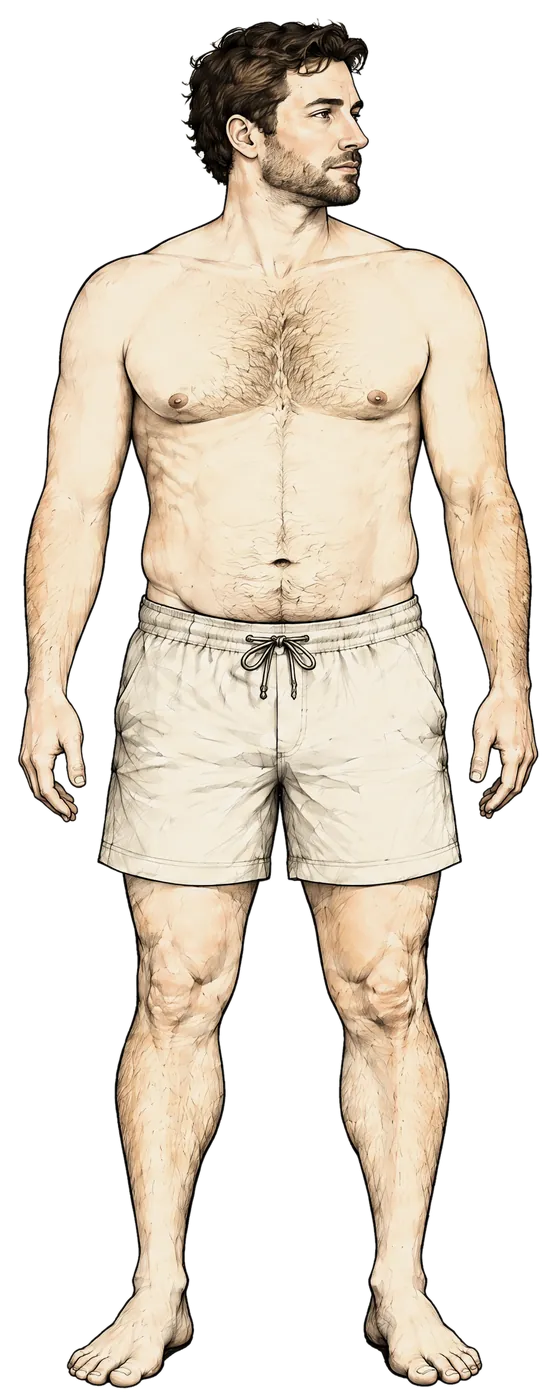
This is a place to understand the basics, make sense of common tests and prepare better questions for your own care. No euphemisms, no scare tactics and no assumption that you already know the language.
Hormones. Testosterone, FSH, LH and other hormones may provide clues about testicular or endocrine function when clinically indicated.
Genetic factors
Genetics. Chromosomal or gene-related factors may contribute, especially in severe sperm-production problems; testing requires appropriate consent and interpretation.
Overall health
Infection and inflammation. Genital-tract infection or inflammation can sometimes be relevant and should be interpreted in clinical context.
Sexual & reproductive health
Sexual function and relationship health. Erections, ejaculation, desire, intercourse timing and the pressure fertility difficulties can place on sex and relationships are legitimate parts of the assessment.
Sperm production and function. Count, concentration, movement, shape and other selected functional measures describe different aspects of semen and sperm health.
Anatomy and obstruction. Varicocele, obstruction, previous surgery, injury, undescended testes and other anatomical factors may be relevant.
Lifestyle & environment
Wider health and lifestyle. Weight, metabolic health, sleep, smoking, alcohol and other health factors can be associated with reproductive health and deserve a non-judgemental discussion.
Medicines, treatment and exposures. Some medicines, anabolic steroids, testosterone treatment, chemotherapy, radiotherapy and occupational or environmental exposures may be relevant.
You can then go deeper through diagrams, short videos, transcripts and referenced articles. Every clinical page will show its author, reviewer and review date.
Understanding the foundations
Learn how sperm are produced, what the testes and reproductive tract do, how the brain and testes communicate through hormones, and what needs to happen for conception.
Read more
The aim is understanding, not a biology exam.
Featured guide: How sperm are made: a clear introduction
Tests and results
Understand semen analysis, hormone blood tests, ultrasound, sperm DNA fragmentation and selected genetic investigations.
Read more
We explain why a test may be offered, what it cannot prove and the questions worth asking before paying for it.
Featured guide: What does a semen analysis tell you?
Health and lifestyle
Smoking, heat, alcohol, weight, sleep, medicines, drugs, illness, diet and occupational exposure can all be relevant in some men.
Read more
Relevance is not the same as blame. We focus on changes that are safe, proportionate and realistic, and we are honest where the evidence is uncertain.
Featured guide: Can lifestyle changes improve sperm health?
Sexual function and relationships
Erections, ejaculation, desire, timing and intimacy are part of fertility care.
Read more
Learn what can change when sex becomes scheduled, when a medical review is useful and how to raise the subject without turning one partner into the problem.
Featured guide: When trying to conceive changes sex
Conditions and next steps
Read about varicocele, azoospermia, low sperm count, infection, inflammation and hormonal or genetic causes.
Read more
A page can help you understand a term; it cannot determine whether it applies to you.
Featured guide: What is a varicocele and can it affect fertility?
Common misunderstandings
Short videos · in production
Film 2 · Animation · 56 sThe male reproductive tract: the factory, storage and plumbingFilm 3 · Animation · 66 sHow a sperm is madeFilm 4 · Animation · 82 sThe hormonal control of sperm productionFilm 5 · Animation · 56 sSperm maturation, semen formation and ejaculationFilm 9 · Animation · 57 sMeeting the egg: capacitation and fertilisationFilm 8 · Animation · 68 sThe sperm journey through the female reproductive tract
Film 2
The male reproductive tract: the factory, storage and plumbing
Sperm are produced in the testes, mature in the epididymis and travel through a long system of ducts.
1 / 8Testes
2 / 8Seminiferous tubules
3 / 8Epididymides
4 / 8Vasa deferentia
5 / 8Seminal vesiclesWords awaited from Anand
6 / 8ProstateWords awaited from Anand
7 / 8Ejaculatory ductsWords awaited from Anand
8 / 8Urethra and penis
Semen is not produced solely by the testes.
Words awaited from Anand
Film 3
How a sperm is made
Sperm production is a complex biological process taking roughly 10–12 weeks before a newly developing sperm can appear in an ejaculate.
1 / 7Inside a seminiferous tubule
2 / 7Sertoli cells supporting development
3 / 7Germ cell
4 / 7Cell division and chromosome reduction
5 / 7Round spermatid
6 / 7Reshaping of head, midpiece and tail
7 / 7Release into the tubule
Changes made today will not alter next week’s result.
Sertoli cells
Testicle
Epididymis
Words awaited from Anand
Film 4
The hormonal control of sperm production
A good blood testosterone level does not necessarily mean good sperm production.
GnRH
LH
FSH
Testosterone
1 / 5Brain/hypothalamus releasing GnRH
2 / 5Pituitary releasing LH and FSH
3 / 5LH stimulating Leydig-cell testosterone
4 / 5FSH and intratesticular testosterone acting through Sertoli cells
5 / 5Exogenous testosterone suppressing LH and FSH
TRT and anabolic steroids can markedly reduce or stop sperm production because the testes lose their internal hormonal stimulation.
Words awaited from Anand
Film 5
Sperm maturation, semen formation and ejaculation
Sperm and semen are different things.
1 / 5Immature sperm entering the epididymis
2 / 5Acquiring motility and functional capacity
3 / 5Moving through the vas
4 / 5Seminal-vesicle and prostate fluids during emission
5 / 5Ejaculation
Obstruction
Retrograde ejaculation
A man can ejaculate apparently normal semen while having very few—or no—sperm within it.
Words awaited from Anand
Film 9
Meeting the egg: capacitation and fertilisation
A sperm must do much more than look normal and swim forward.
1 / 9Capacitation
2 / 9Hyperactivated movement
3 / 9Passage through the cumulus cells
4 / 9Interaction with the zona pellucida
5 / 9Acrosomal changes
6 / 9Fusion with the egg membrane
7 / 9Prevention of additional sperm entry
8 / 9The two pronuclei
9 / 9First cell division
Fertilisation is a sequence of coordinated functional events—not one sperm “drilling” through the egg.
Words awaited from Anand
Film 8
The sperm journey through the female reproductive tract
It is not simply a swimming race won by the fastest sperm.
1 / 5Sperm deposited in the vagina
2 / 5Passage through receptive cervical mucus
3 / 5Temporary cervical storage
4 / 5Movement through the uterus
5 / 5Entry into the fallopian tube
Cervical mucus, uterine movement, timing of ovulation, tubal anatomy and sperm function all contribute.
Words awaited from Anand
Still not sure where to begin?
That is normal. Tell us what prompted your question, how long you have been trying and which results you already have. We can help you choose the least complicated useful next step.